
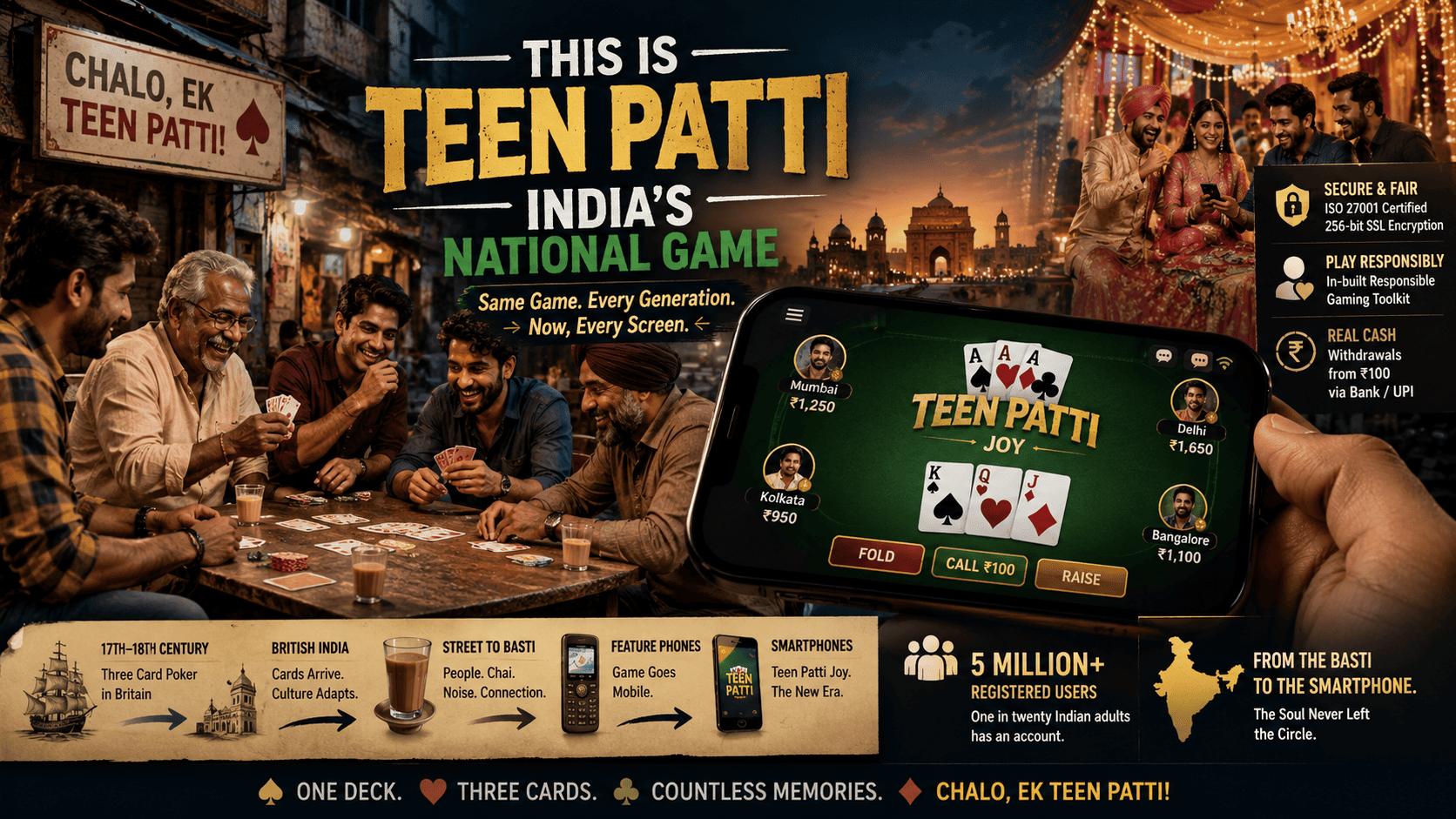
This is Teen Patti, India’s National Game. From the cramped alleyways of Mumbai to the chaos of a Punjabi wedding, from rooftop terraces in Delhi to tea stalls in Kolkata—somewhere, someone is always saying it: “Chalo, ek Teen Patti!”
It’s never just an invitation. It’s a ritual. A way to turn strangers into friends and an ordinary night into something worth remembering.
How popular is Teen Patti in India? It breaks generational barriers better than cricket. Grandparents, parents, freshly-legal kids—everyone sits down and suddenly age doesn’t matter. Cards are dealt, and for a moment, we’re all just players.
Teen Patti wasn’t born in India. But it’s become unmistakably Indian.
The Road from Britain to the Basti
History books will tell you Teen Patti’s ancestor is the Three Card Poker that swept through 17th and 18th century Britain. The East India Company brought cards and gambling culture to South Asia. Locals grabbed it, tweaked the rules, added their own flavor—and within decades, it was something entirely new.
The “Indianization” is the key part.
British Three Card Poker was about odds and casino logic. Indian Teen Patti was always about the people. Stakes could be as low as a cup of chai. The noise level had to be high enough to wake the neighborhood.
You’ll find Teen Patti on street corners, at family gatherings, in the back of auto-rickshaws. It’s never just about the cards. It’s how neighbors settle disputes, how relatives catch up, how weddings finally get moving. One deck, three cards, a soundtrack of cheers and groans—THAT’S the real Teen Patti scene.
Rules Are Simple. The Game Is Not.
Anyone can learn it in five minutes.
Three to six players, one standard 52-card deck (no jokers), three cards each. Hand rankings go from high to low: trail (three of a kind) beats straight flush, which beats flush, which beats pair, which beats high card.
Get a good hand, great. But the real thrill is the betting. Do you call? Raise? Is your opponent actually strong or just bluffing?
A pair shows up about 16.9% of the time. A trail? Just 0.24%.
This design is perfect for social settings. Rules are simple enough for beginners, but reading people—that’s where skill lives. Indians figured this out fast.
From Felt to Touchscreen
Around 2010, smartphones started flooding into India. The feature phone era was ending, and a new era of real-money gaming was beginning.
The first mobile Teen Patti apps were digital copies of the card table. Touchscreen instead of felt, virtual chips instead of cash. But developers quickly realized that wasn’t enough. Online play needed to offer something offline couldn’t.
Teen Patti Joy started in March 2020. Eight people in a rented Bangalore office, with no guarantee it would work. Four years later, over 200 employees and 5 million registered users.
What did they get right?
Multilingual support first. Players can use English, Hindi, Punjabi, or Urdu inside the app. In a country with more languages than most dictionaries, this matters more than you’d think.
Game modes second. They expanded from classic Teen Patti to 30+ variants. Joker Mode adds wild cards that flip strategies. Muflis Mode reverses everything—lowest hand wins. AK47 Mode throws in unique scoring rules. Different flavors for different crowds.
And the big one—real cash withdrawals. Minimum ₹100, processed through bank transfer or UPI. Sounds simple, but it gave online Teen Patti something offline never quite had: the adrenaline of real money on the table.
More Than an App. A Slice of Digital India.
Teen Patti Joy isn’t the only platform, but it’s among the ones taking “national game” seriously.
They got ISO 27001 certified in June 2022. 256-bit SSL encryption means your money and data are locked down. In September 2023 they launched a responsible gaming toolkit—basically a friendly reminder not to lose the plot. That’s important, because Teen Patti’s magic is exactly what makes it addictive, and not many platforms have the honesty to admit that.
Five million users. One in twenty Indian adults has an account. In a country of 1.4 billion, even a fraction of a fraction is a massive number.
Player stories tell you what numbers can’t. Arjun in Mumbai hosts private rooms for old friends scattered across the country. Sneha in Delhi says the withdrawals never fail. Vikram in Bangalore calls it the smoothest Teen Patti experience he’s had. These aren’t testimonials—they’re proof that good online gaming doesn’t replace offline. It extends it.
The National Game’s Next Chapter
Teen Patti has been around for nearly two centuries. British card table to Indian street. Street to feature phone. Feature phone to smartphone. Rules barely changed, but the platform switched multiple times.
Every generation thinks Teen Patti peaked in their time. Grandpa says the 50s version was the best. Dad swears by the 90s. Youngsters claim today’s online versions are the future.
None of them are wrong.
Teen Patti was never really about the cards. It’s about those nights. Those people. Those moments when you say “I call” and the whole table holds its breath.
What Teen Patti Joy does is keep those nights and those people alive across screens. The tech will keep changing. The interface will keep updating. But the noise, the chaos, the connection—that stays.
Next time someone says “Chalo, ek Teen Patti,” remember you’re joining a tradition two hundred years in the making. Except now, the table can be a screen, your opponents can be in different cities, and those three cards in your hand might just be worth ₹100 in real cash.
That’s India’s national game. From the basti to the smartphone, and the soul never left the circle.